
Politics
When Certainty Replaces Thought: Fanaticism and the Collapse of Reason
Iranians Between Ideology and Pahlavism
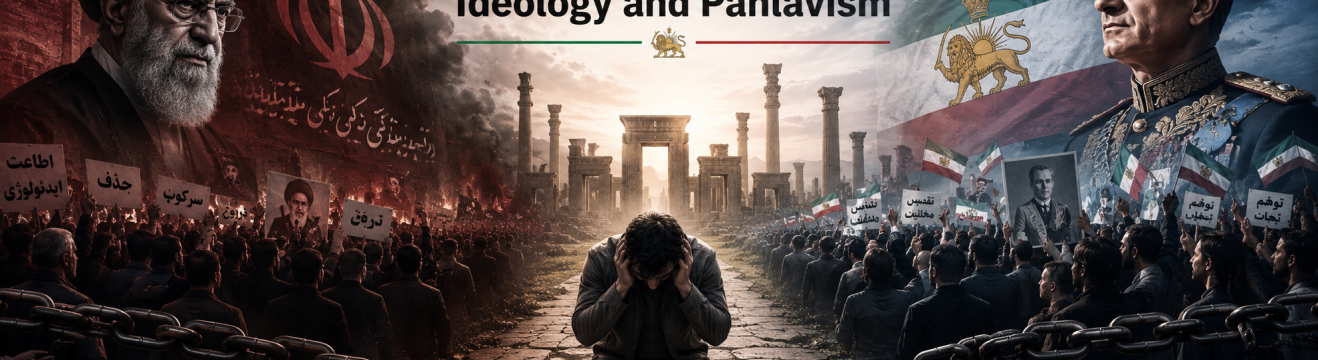
Iranians Between Ideology, Pahlavism, and War (Source: Saman Babaei )
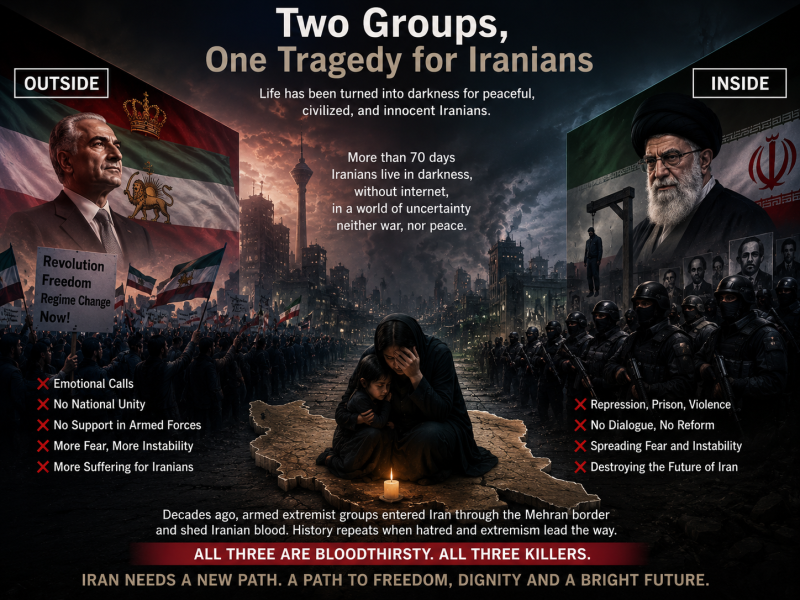
No to both of them
As I write these words, Iranians have spent more than 70 days living in uncertainty, isolation, and fear — trapped in a condition that feels neither like peace nor full-scale war. Large parts of society remain exhausted, disconnected, and psychologically crushed by repression, instability, economic collapse, and political extremism from all sides.
On January 8 and 9, emotional political calls for uprising and confrontation were made before any real national unity had formed among the people, and without visible support or coordination within major state institutions or armed forces. The result was more fear, more instability, and ultimately more suffering for ordinary Iranians.
At the same time, the ruling Islamist establishment — under the leadership of Ali Khamenei and the security structure surrounding him — has for years responded to dissent with repression, imprisonment, violence, and fear instead of dialogue, reform, or national reconciliation.
Perhaps the hardest truth of all is this: many Iranians no longer know where that path is, only that the road they are on is destroying the nation. When internet blackouts, repression, economic collapse, and endless political fanaticism become part of daily life, people do not need a theory to understand the damage — they feel it in their homes, in their wages, in their fear, and in the silence forced upon them.
When Certainty Runs Ahead of Understanding
The Danger of Fanaticism, Personality Cults, and the Erosion of Collective ReasonOne should fear people who know very little, yet speak with absolute certainty; people who make decisions not through understanding reality, but through wishes, emotions, and illusions. More dangerous than them, however, are those who become trapped inside the bubble of loyalty to a person, a movement, or an ideology — because at that moment, a person does not merely lose the ability to analyze; they sacrifice truth itself to fanaticism.
A society in which “belief” replaces “critical examination” quickly becomes an arena of competing certainties with no foundation in reality. In such an environment, everyone sees themselves as the sole owner of truth, while every opponent is viewed not as a critic or rival, but as a dangerous enemy. This is precisely the point where dialogue dies and emotion replaces reason.
Today, more than ever, many societies appear trapped between two forms of blind allegiance — two forces that wear different clothes but, at their core, resemble one another far more than they admit. Both portray themselves as saviors. Both view dissent as a threat. And both attempt to lead people not toward independent thinking, but toward emotional obedience.
On one side stand those who have defended ruling power structures and ideological authority for years — systems whose outcomes, in many cases, have been anger, social division, fear, repression, exclusion, and the psychological exhaustion of ordinary people. These groups often deny mistakes, justify crises, and accept truth only insofar as it serves their narrative.
On one side stand those who have defended ruling power structures and ideological authority for years — systems whose outcomes, in many cases, have been anger, social division, fear, repression, exclusion, and the psychological exhaustion of ordinary people. These groups often deny mistakes, justify crises, and accept truth only insofar as it serves their narrative.
History has repeatedly shown this pattern. From rigid ideological states to authoritarian governments that reshaped reality to preserve themselves, the same mechanism appears again and again. In Nazi Germany, in the era of Stalinist Soviet Union, and during Cultural Revolution, one principle became unmistakably clear: obedience was elevated above truth, critics were erased, and politics transformed into compulsory belief.
On the other side stand groups that present themselves as patriots, reformers, or saviors of the future. Yet instead of building a culture of political maturity and civic responsibility, they once again push society toward dependence on individuals and the glorification of personalities. This is a different kind of danger, but no less serious. A society that replaces institutions, laws, and accountability with devotion to faces and symbols has not escaped the cycle of history — it has merely changed its appearance.
On the other side stand groups that present themselves as patriots, reformers, or saviors of the future. Yet instead of building a culture of political maturity and civic responsibility, they once again push society toward dependence on individuals and the glorification of personalities. This is a different kind of danger, but no less serious. A society that replaces institutions, laws, and accountability with devotion to faces and symbols has not escaped the cycle of history — it has merely changed its appearance.
Across numerous historical experiences, from mass political movements in twentieth-century Europe to authoritarian systems in parts of Asia and Latin America, one lesson has remained consistent: when the “individual” replaces the “institution,” the result is usually concentrated power, weakened civil society, suppression of criticism, and eventually the decline of democratic culture itself.
The issue is not merely different names or different flags. The real issue is that both currents ultimately distance human beings from independent thought. One does so in the name of ideology; the other in the name of saving the nation. Yet the outcome can become identical: people who no longer ask questions, but merely choose under which flag they wish to stand.
The issue is not merely different names or different flags. The real issue is that both currents ultimately distance human beings from independent thought. One does so in the name of ideology; the other in the name of saving the nation. Yet the outcome can become identical: people who no longer ask questions, but merely choose under which flag they wish to stand.
The most dangerous people are not always the most ignorant. Sometimes, the most dangerous are those possessed by absolute certainty — people convinced they hold the complete truth and that anyone who disagrees with them must either be a traitor or a fool. History has written the cost of such certainty in blood.
From political purges and staged trials to civil conflicts and widespread repression, the same pattern has repeated throughout history: wherever questioning becomes synonymous with betrayal, societies begin their descent into decay.
The blood that is shed, the hatred that deepens every day, and the gradual collapse of dialogue and rationality within society are never the product of only one side. When power sacrifices truth for the sake of self-preservation, it is guilty. And when the opposing force, instead of strengthening independent thought, reproduces a culture of hero worship and emotional dependency, it too becomes responsible.
From political purges and staged trials to civil conflicts and widespread repression, the same pattern has repeated throughout history: wherever questioning becomes synonymous with betrayal, societies begin their descent into decay.
The blood that is shed, the hatred that deepens every day, and the gradual collapse of dialogue and rationality within society are never the product of only one side. When power sacrifices truth for the sake of self-preservation, it is guilty. And when the opposing force, instead of strengthening independent thought, reproduces a culture of hero worship and emotional dependency, it too becomes responsible.
Betrayal is not limited to direct repression. Sometimes betrayal means leading an entire nation back into the cycle of illusion, fanaticism, and the worship of individuals.
No country has ever been saved through the sanctification of human beings. No society has ever reached freedom through blind obedience. On the contrary, wherever people became afraid of criticism — or replaced criticism with hostility — the slow process of decline quietly began.
The salvation of a nation begins only when people learn that no individual is sacred, no power is beyond criticism, and no flag should ever replace reason. A society whose people lose the ability to think independently will, sooner or later, lose not only truth and justice, but also its future.
No country has ever been saved through the sanctification of human beings. No society has ever reached freedom through blind obedience. On the contrary, wherever people became afraid of criticism — or replaced criticism with hostility — the slow process of decline quietly began.
The salvation of a nation begins only when people learn that no individual is sacred, no power is beyond criticism, and no flag should ever replace reason. A society whose people lose the ability to think independently will, sooner or later, lose not only truth and justice, but also its future.
This commentary by Saman Babaei stands as a clear and direct position: criticizing power, political movements, and influential personalities is not hostility toward society — it is a necessary condition for political maturity. Any society still trapped in personality cults, the elimination of dissent, and emotionally driven politics will face profound challenges in achieving sustainable democracy.
The aspiration is simple, yet essential: to build a society in which people defend their dignity through awareness, responsibility, and solidarity — a society guided not by manipulation and slogans, but by understanding, cooperation, and independent thought.
The aspiration is simple, yet essential: to build a society in which people defend their dignity through awareness, responsibility, and solidarity — a society guided not by manipulation and slogans, but by understanding, cooperation, and independent thought.
Liability for this article lies with the author, who also holds the copyright. Editorial content from USPA may be quoted on other websites as long as the quote comprises no more than 5% of the entire text, is marked as such and the source is named (via hyperlink).